
X
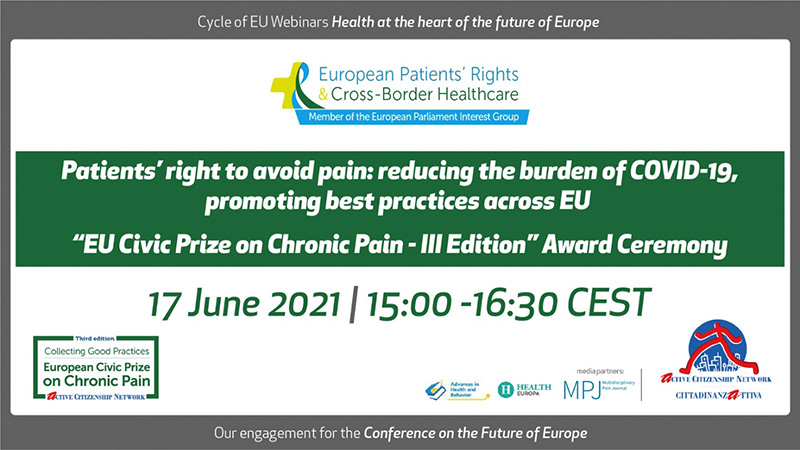
Active Citizenship Network (ACN) is glad to invite you on 17th June, 2021 from 15.00 to 16.30 CEST to the event “Patients’ right to avoid pain: reducing the burden of COVID-19, promoting best practices across EU”. It will be held in the framework of the cycle of EU Webinars «Health at the heart of the future of Europe», which ACN will hold to feed the debate of the Conference on the Future of Europe and it will include the Award Ceremony of our bi-annual project: European Civic Prize on Chronic Pain Collecting Good Practices - III edition 2020-2021.
The event will start by discussing the impact of Covid-19 on chronic pain patients, with concrete experiences and data from patients and healthcare professionals, also telling how the EU institutions are working in support of the topic and the innovation development. It will continue describing the European Civic Prize on Chronic Pain project and awarding the 4 winners and also the next steps about chronic pain management and policy will be discussed, focusing on paediatric and cancer pain.
This multi-stakeholder event – which will involve representatives of the civil society, patients, experts and institutions - has the aim to demonstrate what this community can offer in terms of raising awareness about the phenomenon, enhancing the body of knowledge of positive cases and successful experiences, and strengthening commitment to this topic.

Along 2021, Active Citizenship Network signed new Memorandum of Understanding with European Munltidisciplinary Network in Pain Research and Education (EMNIPRE), a network of doctors specializing in pain treatment.

Along 2021, Active Citizenship Network signed new Memorandum of Understanding with Sociedad Española Multidisciplinar del Dolor (SEMDOR), which is a new scientific society on pain with a multidisciplinary approach in which doctors, pharmacists, psychologists, physiotherapists, nurses and other health specialists interested in pain are integrated to constitute a society in the fight against pain.
Along 2021, Active Citizenship Network signed new Memorandum of Understanding with Asociación Española de Pacientes Contra el Dolor (APDOL), a non-profit association whose main purposes are to inform and advise the population in general, and specifically to patients and families who suffer from pain, to promote research on pain mechanisms and syndromes, as well as helping to improve the treatment of patients with acute and chronic pain, grouping scientists, doctors and other health professionals from different disciplines and areas, who share an interest in research on pain and its treatment.

Along 2021, Active Citizenship Network signed new Memorandum of Understanding with Sine Dolore European Pain Foundation, the entity that promotes since many years the “SINE DOLORE WORLD PARK”, the only theme park in the world against pain and quality of life.

Along 2021, Active Citizenship Network signed new Memorandum of Understanding with Excellence in Pediatrics Institute (EIPI), an association that provides continuing medical education to a global network of over 45,000 child health care professionals. EIPI's purpose is to act as a hub for sharing the latest developments and advice with all stakeholders involved in the care of children and adolescents.
In the past months, Active Citizenship Network published several articles focused on pain, on international peer review journals, healthcare specialized media and generalist journals.
They are listed below:

In line with the strategies and objectives of the European Union and Europe's Beating Cancer Plan of February 2021, Cittadinanzattiva, with the support of Novartis, on the 28th of January 2021 launched, "Together for the Oncology of the Future”, which put together around a virtual table over 60 Italian realities representing the institutions, universities, research bodies, civil society with a know-how linked both to the clinical-health world and to the fields of economics, sociology, the environment, philosophy, innovation and work. The goal is to outline in a Strategic Document on the future of Oncology, to be delivered to the Institutions, about priorities and policy actions centred on individuals, also in the light of the European Charter of Patients’ Rights that will contribute to changing the approach to oncology by 2030.
Recently, Active Citizenship Network published also several articles about cancer on international peer review journals, healthcare specialized media and generalist journals.
Please, find them below:
HEALTH EUROPA (6th May 2021): Tackling cancer care inefficiencies in Europe’s future (for the download, click here)
DIÁRIO DE COIMBRA (18 Apr. 2021): Fórum Europeu discute prevenção do cancro em tempo de pandemia (PT)
SAPO-LIFESTYLE (16 Apr 2021): COVID-19: Fórum Europeu vai discutir a prevenção do cancro em tempo de pandemia (PT)
NOTÍCIAS AO MINUTO (16 Apr 2021): Fórum Europeu vai discutir a prevenção do cancro em tempo de pandemia (PT)
CANAL S+ (16 Apr 2021): Covid-19: Fórum Europeu vai discutir a prevenção do cancro em tempo de pandemia (PT)
FAMILY MEDICINE AND MEDICAL SCIENCE RESEARCH (Vol.10 Iss.3 No:262 - published on 16-03-2021): A Civic Audit to Monitor Oncological Facilities across Italy: an Advocacy Tool in Line with the New Ambitious EU4Health Programme
JOURNAL OF MEDICAL RESEARCH AND HEALTH SCIENCES (JMRHS) (Volume 04 Issue 03 March 2021): Europe’s beating cancer plan & citizens’ engagement – The Manifesto for the right to personalized medicine for cancer patients
MATHEWS JOURNAL OF NURSING AND HEALTH CARE (Volume 2, Issue 1 - 2020): The Relevance of the “Charter of Rights against Unnecessary Pain” in the Framework of the Europe’s Beating Cancer Plan
TRENDS IN MEDICINE (Volume 20: 1-3): Europe’s beating cancer plan & citizens’ engagement – The case history of the civic monitoring of onco-hematological Day Hospitals across Italy
ENGAGE is a bold EU-funded project whose mission is to provide novel knowledge, impactful solutions and emergency response guidelines for exploiting Europe ´s societal resilience. Solutions will aim at bridging the gap between formal and informal approaches to risk and emergency management, increasing the ability of communities to adapt before, during and after disaster. This project has received funding from European Union’s Horizon 2020 Research and Innovation Programme under Grant Agreement N° 882850.
The ENGAGE consortium brings together the expertise of 14 partners across 8 European countries, and Cittadinanzattiva is involved both at national level and, through its EU branch Active Citizenship Network, also at European level.
With this project Cittadinanzattiva confirms its commitment to making human settlements more inclusive, safe, resilient and sustainable and its interest in activities aimed at achieving the objectives of the 2030 Agenda. To be updated, please subscribe to the dedicated newsletter.
Cittadinanzattiva APS
p.iva: 02142701008
via Imera, 2
00183 Roma
Tel: (+39) 06.36.71.81
Fax: (+39) 06.36.71.83.33
Rue Philippe Le Bon, 46
1000 Brussels - Belgium