X
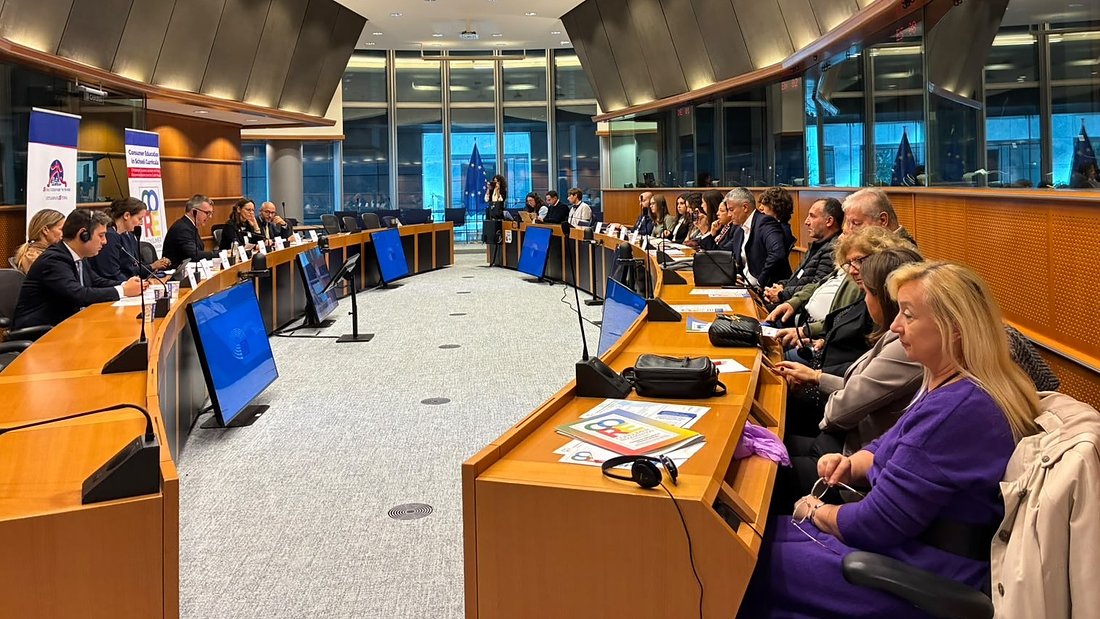
Bruxelles – 14 October 2026. Embed consumer rights into existing civic education, digital skills, sustainability, and financial literacy programmes; move beyond short-term, ad-hoc projects by securing multi-annual funding and accredited teacher training; establish a common European framework for consumer competences for children and young people, aligned with DigComp and GreenComp; and recognize civic associations – starting with student organizations and consumer groups – as strategic educational partners capable of bringing real-world case studies, continuous updates, and methodological support into classrooms. These are among the main Recommendations presented, on 14 October 2026, at the European Parliament during the event "Consumer Education in School Curricula: Challenges, Lessons Learned and Policy Recommendations".
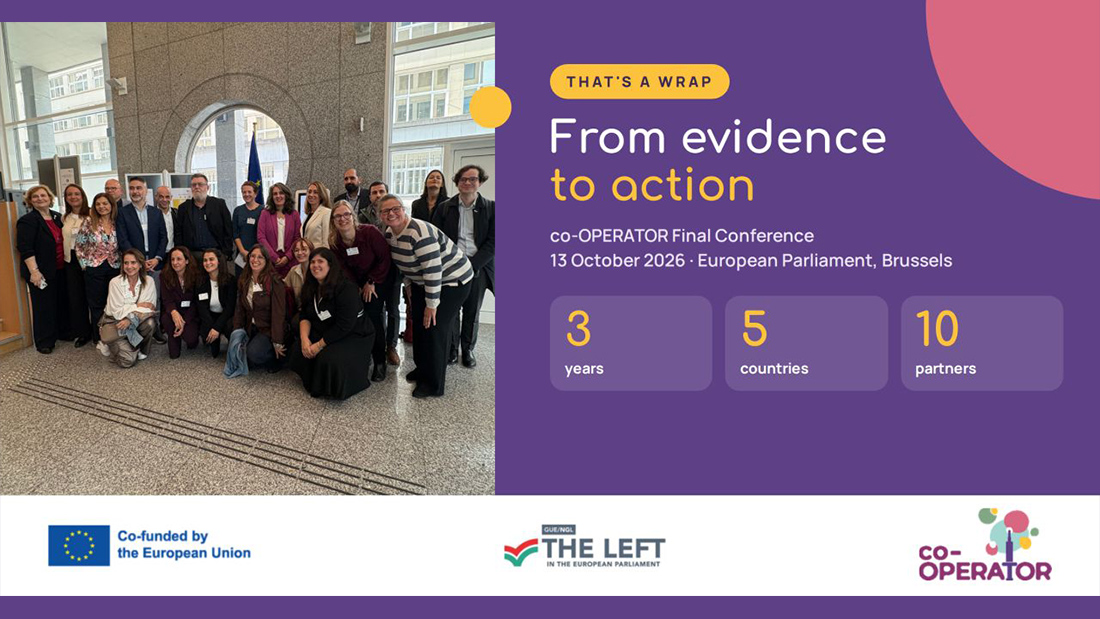
On 13 October 2026, the co-OPERATOR Final Conference brought together researchers, health professionals, civil society and EU institutions at the European Parliament in Brussels and online. We were hosted by MEP George Georgiou with the support of The Left in the European Parliament.
Coordinated by the Cyprus University of Technology and funded by the EU4Health programme, co-OPERATOR brings together 10 partners from Cyprus, Greece, Italy, Portugal and the Netherlands.

BRUSSELS, July 8, 2026 – Facing approximately 1 million avoidable deaths per year among people under 75 in the European Union, the transition from a reactive, treatment-based healthcare system to a proactive model founded on personalised prevention is a documented priority for public health agendas.
On July 8, at the Royal Library of Belgium in Brussels, the Final Conference of the EU-funded PROPHET project was held to present and review the outcomes of four years of collaborative research.
The event brought together representatives from all 18 members of the multidisciplinary PROPHET consortium, spanning 12 European countries. Their participation reflected a strong collaborative effort across universities, research infrastructures, public institutions, and citizens’ and patients’ organisations.

PROPHET presented its Strategic Research and Innovation Agenda (SRIA) at the European Parliament in the framework of the XX European Patients’ Rights Day: a concrete roadmap to bring personalised prevention from research into the everyday lives of European citizens.

XX European Patients' Rights Day
12 May 2026 - European Parliament, Brussels
Personalised prevention must become a right for every citizen, not a privilege for a few
Personalised prevention must become a right for every citizen — not a privilege for a few. This was the central message of the XX European Patients' Rights Day, held on 12 May 2026 at the European Parliament in Brussels.
Organised by Cittadinanzattiva and its EU branch, the Active Citizenship Network, the event brought together EU institutions, researchers, patient organisations, healthcare professionals, and civil society to mark the twentieth anniversary of this initiative and to explore a new frontier in health policy: personalised prevention. More than 40 participants attended in person from at least 18 different countries, and the event received over 150 requests for online participation from 34 countries — a sign of the growing interest in this topic.
“Twenty years marks a significant milestone — not only because of the continuity of this initiative, but because it demonstrates the strength of a vision: a Europe of health built on rights, human dignity, and the active participation of citizens. The right to prevention was there from the very beginning. Today we are not simply celebrating it. We are watching it evolve — and we must be ready for it” said Daniela Quaggia, Senior Manager at Cittadinanzattiva-Active Citizenship Network.

"The whole framework of the European Health Data Space (EHDS) cannot stand without a solid foundation of patients' rights protection. For this reason, we welcome and commend the Polish institutions for the high political value of their decision to include the topic of patients' rights in the Programme of the Polish Presidency of the Council of the European Union, effectively placing it at the centre of the European political agenda. As highlighted in the recently published White Paper “Healthcare Policy Recommendations”, the commitment to adopt concrete measures toward the official recognition of the European Charter of Patients' Rights - originally drafted in 2002 by Active Citizenship Network together with civil and patients’ organizations from across Europe - marks a pivotal step forward". This was the message delivered by Mariano Votta, Director of Active Citizenship Network, during the celebration of the 19th European Patients’ Rights Day.

MEP Ondřej Dostál (NI, Czechia) and MEP Brando Benifei (S&D, Italy) signing the open letter
42 civic, patient and health professional organisations, supported by 5 MEPs from the two largest political groups in the European Parliament (EPP and S&D), have addressed an open letter to the newly elected European Commissioner for Health and Animal Welfare, Olivér Várhelyi. This joint effort, led by Cittadinanzattiva - Active Citizenship Network and RPP Group, aims to underline the urgency of tackling Europe’s health workforce crisis to protect citizens’ right to health.
The letter urges Commissioner Várhelyi to prioritise the strengthening of the health workforce, recognising it as a cornerstone of equitable and effective healthcare systems across Europe.
The letter was signed by MEPs Brando Benifei (S&D, Italy), Ondřej Dostál (NA, Czech Republic), Loucas Fourlas (EPP, Cyprus), András Kulja (EPP, Hungary), Tomislav Sokol (EPP, Croatia) and associations from Austria, Bulgaria, Cyprus, Croatia, France, Greece, Ireland, Italy, Latvia, Malta, the Netherlands, Poland, Portugal, Romania, Slovenia and Spain.

The key role of HCPs for a healthier Europe
Combining the protection of patients' rights with skills shortage,
medical desertification and job strain
20 March 2024 | European Parliament, Brussels
New EU Institutions are called to tackle the health workforce crisis, the main pre-condition for a greater protection of patients' rights across Europe.
We call on European policy-makers to address the health workforce crisis by implementing solutions that prioritize the well-being of health workers, probably the main precondition for better protection of patients' rights across Europe. This message, also framed in a pre-electoral context, emerged during the celebration of the XVIII European Patients’ Rights Day, which was, as always, organized at the EU Parliament in Brussels by Active Citizenship Network, the EU branch of the Italian NGO Cittadinanzattiva.
The pandemic has exacerbated existing issues such as workforce and skills shortages, medical desertification, and job strain, as highlighted by the first civic survey on health personnel presented on this occasion. This survey was conducted in Italy by Cittadinanzattiva in collaboration with the FNOPI, FNO TSRM, and PSTRP Federations. The study offers insights into the professional conditions of 10,000 workers representing 20 different health professions.

The NIGHTINGALE project, funded by the European Union, conducts a mass casualty incident drill in Novara from 18 to 20 October 2023. The exercise aims to put innovative technologies developed by NIGHTINGALE partners to the test in controlled but realistic conditions of mass casualty incidents, including such situations as terrorist attacks, building collapse, and transportation incidents.
The event is organised and hosted by the Centre for Research and Training in Disaster Medicine,Humanitarian Aid and Global Health, Università del Piemonte Orientale (Novara, Italy) and the Italian Red Cross Committee.

On 26 April 2023, the European Commission published a proposal for the revision of EU General Pharmaceutical Legislation, with the objectives to ensure access to affordable medicines, address unmet medical needs, support competitiveness, innovation, and sustainability of the EU’s pharmaceutical industry, enhance crisis preparedness and response and address medicines shortages1. Vaccines play an important role in achieving these objectives.
The European Commission aims, as part of its revision of the Pharmaceutical Package, to formalise the definition of Unmet Medical Needs and to enhance incentives for innovation in areas of UMN. Currently, there is no established, unified definition for UMN, although the concept of UMN is used, throughout medicines’ lifecycles and the value chain for i.e. directing public funds for R&D, determining eligibility to PRIME, accelerated assessment, conditional regulatory approval and orphan designation.
Cittadinanzattiva APS
p.iva: 02142701008
via Imera, 2
00183 Roma
Tel: (+39) 06.36.71.81
Fax: (+39) 06.36.71.83.33
Rue Philippe Le Bon, 46
1000 Brussels - Belgium